
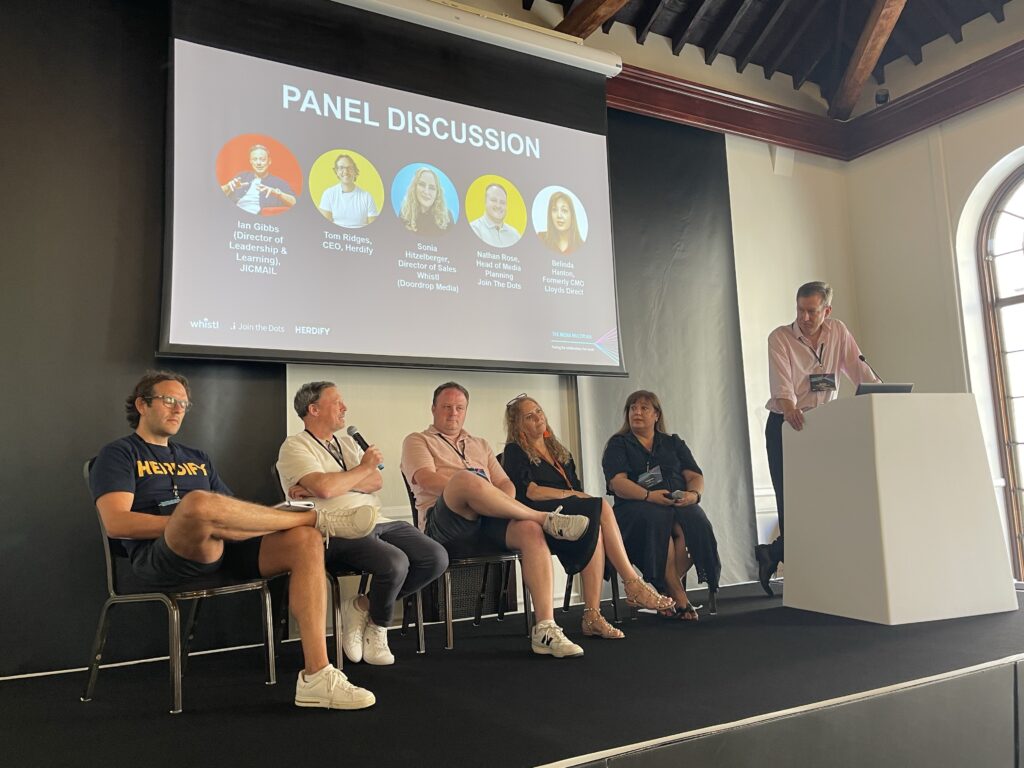
Here’s our roundup of the key evidence presented at our The Media Multiplier event. Together with Whistle and Herdify we presented a series of talks covering advertising effectiveness, the role of mail in a multi-channel plan, and why the question most marketers are asking might be the wrong one. The presentations were specific, the numbers were citable, and some of the conclusions cut against where the market has been putting its money.
The business case for advertising is stronger than the noise suggests
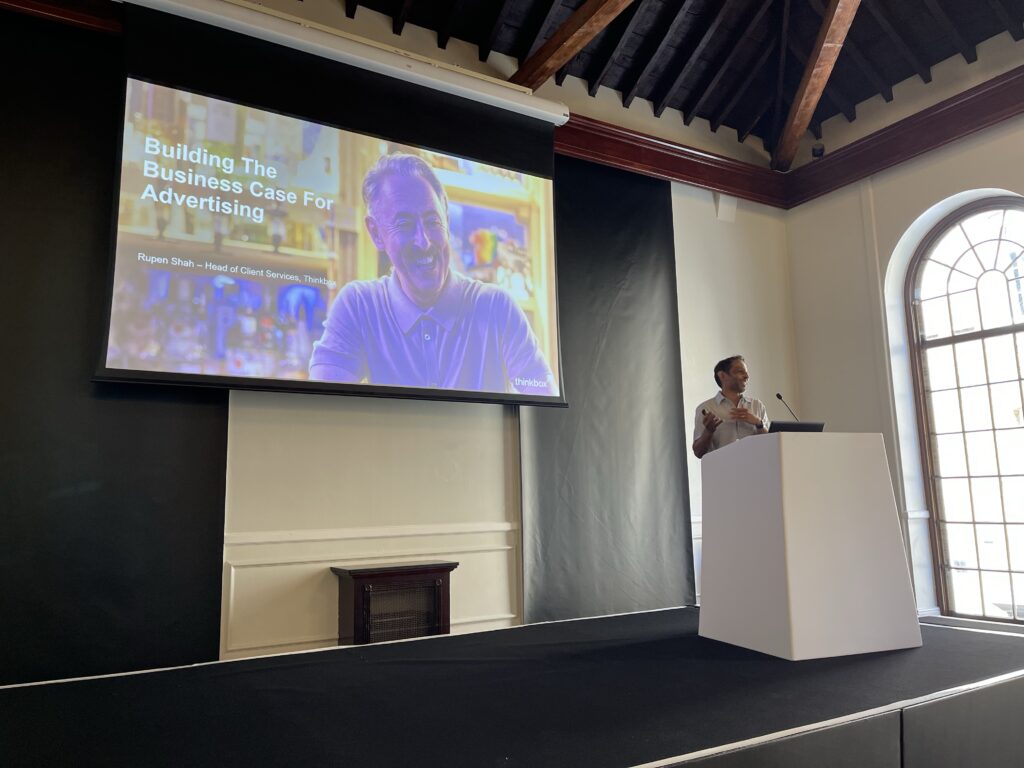
Rupen Shah from Thinkbox opened with Profit Ability 2, covering 141 brands, £1.8bn of media spend, and ten channels across 14 sectors. The headline: advertising ROI has not fallen. The all-channel average short-term profit ROI is £1.87 for every £1 spent, and over two years, accounting for sustained effects, it rises to £4.11.
A few things in the data that tend to get missed:
- 58% of total advertising-driven profit comes from sustained effects: the carryover and long-tail impact that builds beyond the 13-week short-term window. Marketers optimising purely for immediate response are leaving more than half the value on the table
- The channel story also cuts against the current spend allocation. Online display reduced its spend and improved its ROI, while paid social increased its spend and saw its ROI fall. The data does not say paid social is broken; it says the market has been overpaying for it
- Linear TV is the single largest driver of full profit volume, at 46.6% of the total across all channels. Its saturation point, the weekly spend level at which incremental returns start falling sharply, is £330,000, against £123,000 for the next highest channel. That gap matters when you are making allocation decisions at scale
- Sector shapes the numbers in ways that all-sector benchmarks tend to flatten. Retail (large format) returns a full profit ROI of £6.93, while FMCG returns £1.95. The same channel, in a different sector, with a different margin structure, produces a completely different result
The multiplier is real, and TV is the engine of it
The Profit Ability 2 data on cross-channel effects is the part that should change how plans get built. Media channels don’t perform independently, and when TV is in the plan, purchase intent across other channels improves by 38.9% on average. The average improvement across performance channels specifically: 13.7%.
The matrix from the Demand Generation research puts numbers on the mechanism. TV generates a 31% uplift in social media’s effect, a 31% uplift in online display, a 54% uplift in cinema, and a 20% uplift in direct mail. The direction is consistent: reach-building, trusted channels amplify each other.
Trust has moved up the effectiveness rankings, with IPA Databank data from 2016 to 2024 now putting it as the second highest-ranked metric linked to business effects. There is also a measurable relationship between perceived campaign cost and consumer trust: as one goes up, so does the other. This is the principle of costly signalling, and it matters because choosing cheap, low-attention channels has a cost that does not appear in the media plan but does appear in brand trust over time.
The Credos Trust Tracker makes the channel implications concrete: television at 46%, direct mail at 35%, social media at 25%, influencer marketing at 22%. Where the message sits carries weight.
JICMail and Super Touchpoints: The planning framework that changes the question
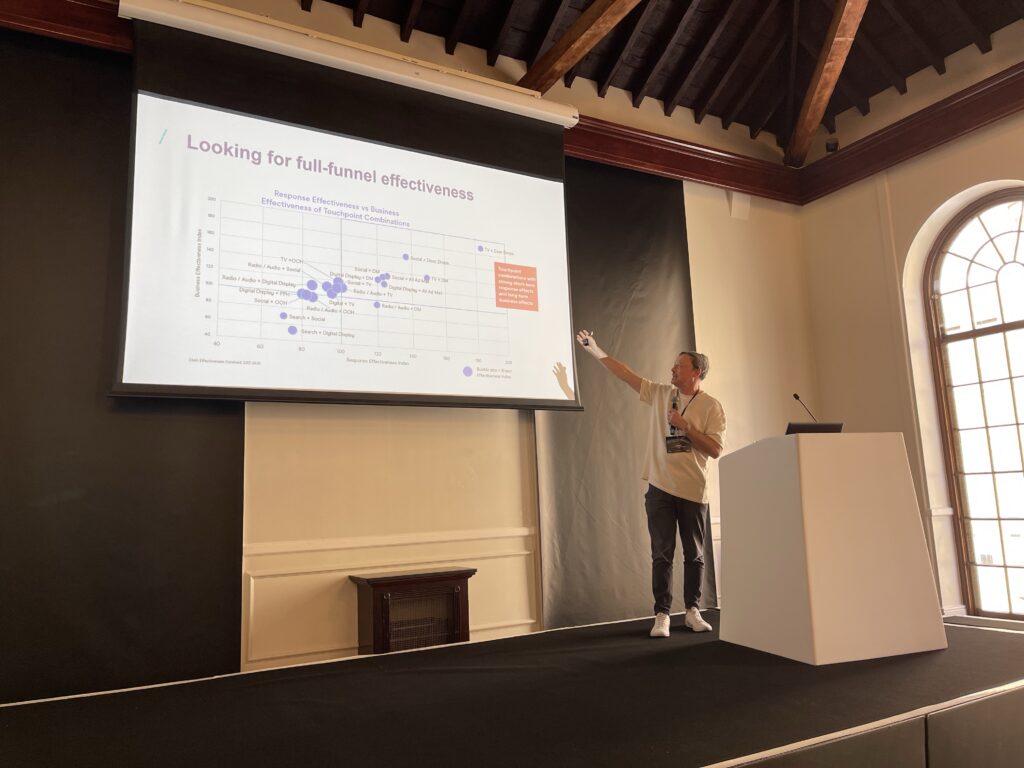
Ian Gibbs from JICMail presented the Super Touchpoint planning framework, and the core finding does not get enough attention in planning conversations.
Acquisition effectiveness peaks at 10 or more channels, while efficiency (cost per acquisition) peaks at 2 or more. Those two facts are not contradictory: adding channels beyond two does not improve efficiency, but it does improve total acquisition volume, which is the distinction CPA-led planning tends to miss.
Mail and traditional media score well on Super Touchpoint qualities (attention, trust, tangibility, longevity), and the TGI integration with JICMail data is now live across 9,000 postcode sectors. That means you can identify audiences by their actual mail behaviour and plan against it, not against assumed reach.
When it comes to attention: door drops are interacted with 3.1 times on average and receive 60 seconds, while direct mail receives 145 seconds over 28 days and is interacted with 2.9 times. 77% of mail is read or looked at, an all-time high as of Q4 2025. These are not brand sentiment metrics; they are the numbers that say whether a channel is doing any work.
Real life is a channel too
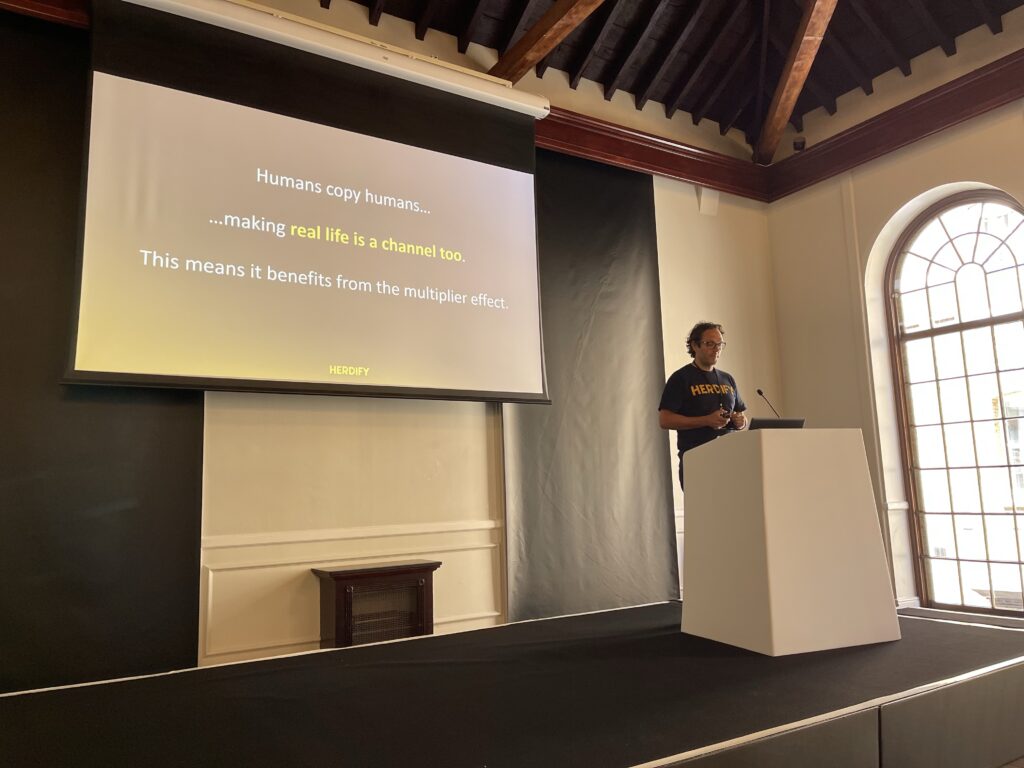
Tom from Herdify made the case for something most media plans do not account for: social contagion in the offline world.
Human decision-making has not meaningfully changed. People default to doing what they have always done, or copying those around them, and marketing strategy tends to address only the first of those. The second is largely ignored.
60% of journeys are under five miles, and adoption is a local condition, not a national curve. Centola’s research on complex contagion adds something the aggregate diffusion models miss: complex behaviours like switching brands, making donations, or starting a subscription require multiple exposures from multiple people within a social network, not a single broadcast touchpoint.
The question that follows is a different one from the standard targeting brief. Not “who is likely to buy?” but “where is buying already being socially reinforced?” Targeting word-of-mouth hotspots produced a 120% improvement in door drop response rates and a 483% improvement in OOH new customer penetration for one challenger brand, with 3.4x more new customers acquired in a category dominated by entrenched competitors with bigger budgets.
Mail and print in an integrated plan: What the numbers show
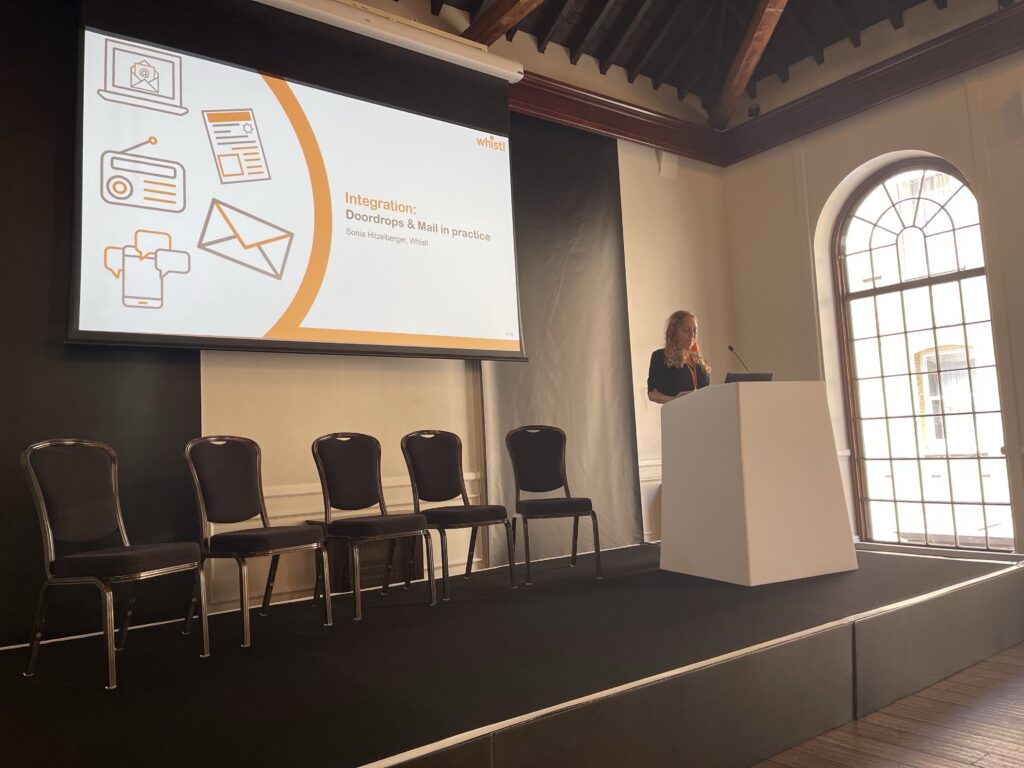
The consistent finding from Whistl’s campaign data is that mail channels amplify each other. Combining direct mail with door drop produces an average 40% increase in direct mail response rates. One charity client saw their response rate fall 212% in the week their door drop didn’t land alongside the mail, which tells you something about what the door drop was doing in the weeks it did. The cross-channel effect also runs into digital: 9.2% of mail recipients visited an advertiser’s website in the most recent JICMail measurement period, a five-year high, and people primed by mail spend 30% longer on a brand’s promoted social post. 53% of mail-driven purchases now complete online. Mail doesn’t pull people away from digital; it sends them there in better shape.
The RSPCA winter appeal, which Join the Dots planned and delivered, is worth looking at as a worked example. The targeting model combined a donor lookalike build, Mosaic Bullseye audiences (Prestige Positions, Country Living, Rural Reality), a TGI overlay for behavioural propensity, decile prioritisation, vulnerability exclusion filtering, and Herdify community scoring across 1 million households. Four creative tests ran simultaneously, each pre-tested via 3M VAS visual attention technology before going to print, with the Herdify cells forecast to deliver a 14% response rate uplift, tracked via full match-back attribution.
Print used at that level of precision is a different proposition from print as broadcast. The attention and trust properties are there regardless; what changes is whether the targeting earns them.
What the evidence says about how to plan differently
There is a time horizon problem. Short-term optimisation captures 42% of the value advertising generates, while the other 58% comes from sustained effects measured over two years. If the reporting cycle and budget review process only reward short-term metrics, budget will keep moving toward channels that look good at week 13 and look worse at week 52. The planning frame needs to match the actual payback profile, or the decisions will keep being wrong in the same direction.
There is an attention cost problem too. Meta CPM is up 89% in three years, the average time spent on a display ad is 3 seconds, and direct mail receives 145 seconds over 28 days. The cost per second of genuine attention looks very different from the headline CPM, and that gap has been widening. Cheap impressions are cheap for a reason.
And there is an isolation problem. No channel should be evaluated on its own performance alone, because TV lifts every channel around it, mail lifts digital response rates, and word-of-mouth hotspots lift every channel targeting them. Treating each channel as a separate budget line, with a separate ROI target, misses most of where the value actually comes from.
The Thinkbox Media Mix Navigator and JICMail planning tools exist to help answer the combined question with data. The evidence from The Media Multiplier event is that the brands treating this as a single connected planning problem are getting better results than the ones who are not.
At Join the Dots, we plan print and data-led media for charity and commercial clients. If the numbers here raise questions about your current mix, get in touch.