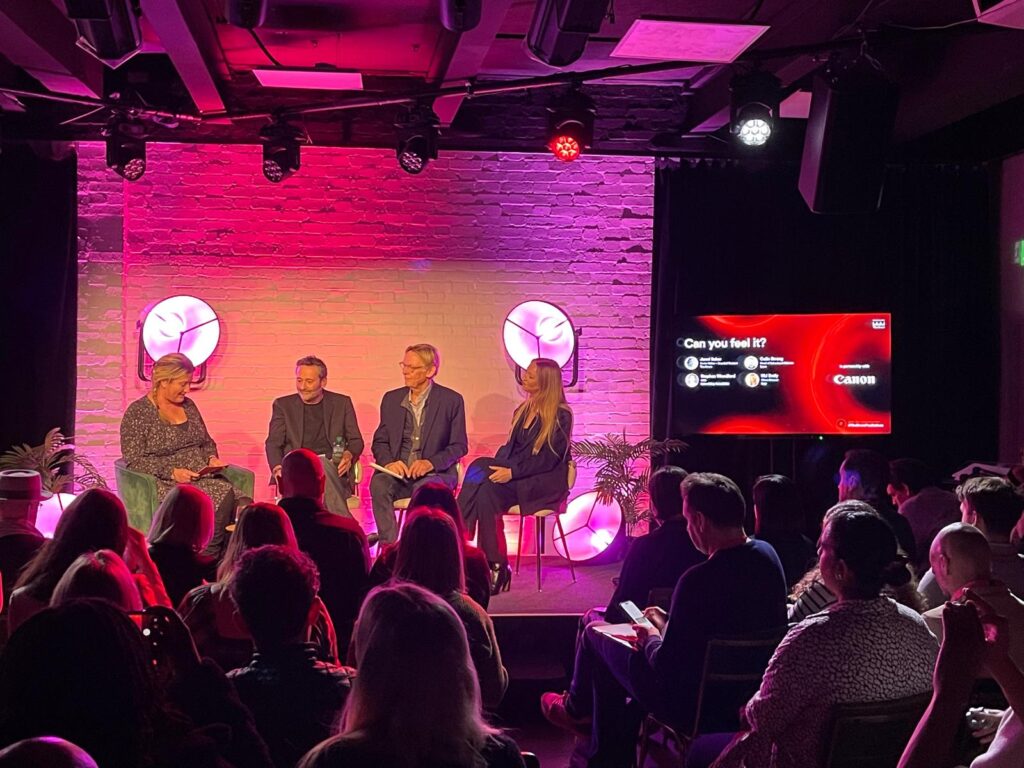
The Drum’s Predictions 2026 event, hosted by Lynn Lester and Richard Draycott, brought together leaders from across the industry to make sense of where marketing is heading in a world shaped by uncertainty, automation and constantly shifting human behaviour. What stood out was not another rush towards the newest tools but a genuine return to judgement, brand strength and human relevance. Across planning, AI, customer experience, media and culture, the same theme appeared again and again. The fundamentals matter more than ever, but only when we apply them with real intent.
Global moments, fragmented attention and the reality of reach
Charlie Wade from VML Live opened with the 2026 World Cup and a clear insight. Even the biggest cultural moments no longer guarantee sustained attention. People rarely watch a full match anymore. They experience sport in short bursts through highlights, clips, podcasts, second screens and quick spikes of emotion. Live sport still has cultural weight, but the way audiences engage has changed.
For brands, the job is no longer about buying scale. It is about understanding where connection genuinely happens. Context, the device and the format define the attention you earn. Wade encouraged marketers to think more carefully about the true role their product plays in these moments instead of relying on loose association and hoping for the best.
The big questions CMOs need to answer and AI in practice: Acceleration without abdication
Moderated by Cameron Clarke, this combined session brought together senior marketers from HSBC, General Mills, Oracle Red Bull Racing and Analytic Partners. Each of them is facing the same challenge. How do you deliver growth in a world that moves too quickly for traditional planning and too unpredictably for comfortable resource allocation?
Nicole German from HSBC explained that annual planning has largely lost its usefulness. Markets shift too quickly and too often for fixed plans to hold. HSBC now works with rolling planning cycles that blend clarity of direction with room for unprompted activity, often a 60 to 40 or 70 to 30 split. The intention is not to abandon strategy but to keep it alive rather than frozen.
Caroline Buckland from Oracle Red Bull Racing reinforced this by explaining how their team builds flexibility into the plan from the outset. They have created pre‑agreed decision frameworks, which means that when conditions shift, the response is already defined. This avoids panic, maintains focus and allows them to move at pace and with confidence.

Eileen Hanna at General Mills was direct. Planning beyond a year simply does not reflect the world we operate in. What matters is knowing the destination and being willing to adjust the route as conditions change. Her comparison to navigating a flight made the point clearly. Turbulence is inevitable, but the destination remains the same.
Joy Talbot from Analytic Partners grounded the discussion in evidence. Predictive modelling and counterfactual analysis have become essential in demonstrating where the business would be without marketing investment. In an environment where budgets face heavier scrutiny, this level of clarity matters more than ever.
Running through this entire section was the role of AI, which the panel approached with refreshing balance. Oracle Red Bull Racing use AI where it excels, particularly optimisation and number analysis, while still treating brand credibility and authenticity as the real differentiators. HSBC use AI to understand how customers interact with AI agents during their search and decision journeys. However, Nicole German made it clear that AI lacks context. It can support decisions, but it cannot make them.
General Mills added one of the most valuable reframings. As AI produces more and more answers, the role of the marketer is shifting from generating solutions to judging them. Brand health still drives commercial performance, and translating it into a form that leadership understands is becoming a defining skill.
The merged conclusion was unmistakable. The landscape is volatile, resources are tightening and technology is accelerating. None of this reduces the need for human judgement. It increases it. Awareness is not connection. Relevance builds connection, connection builds trust and trust cannot simply be renewed once spent.
Customer experience 3.0: Empathy as infrastructure
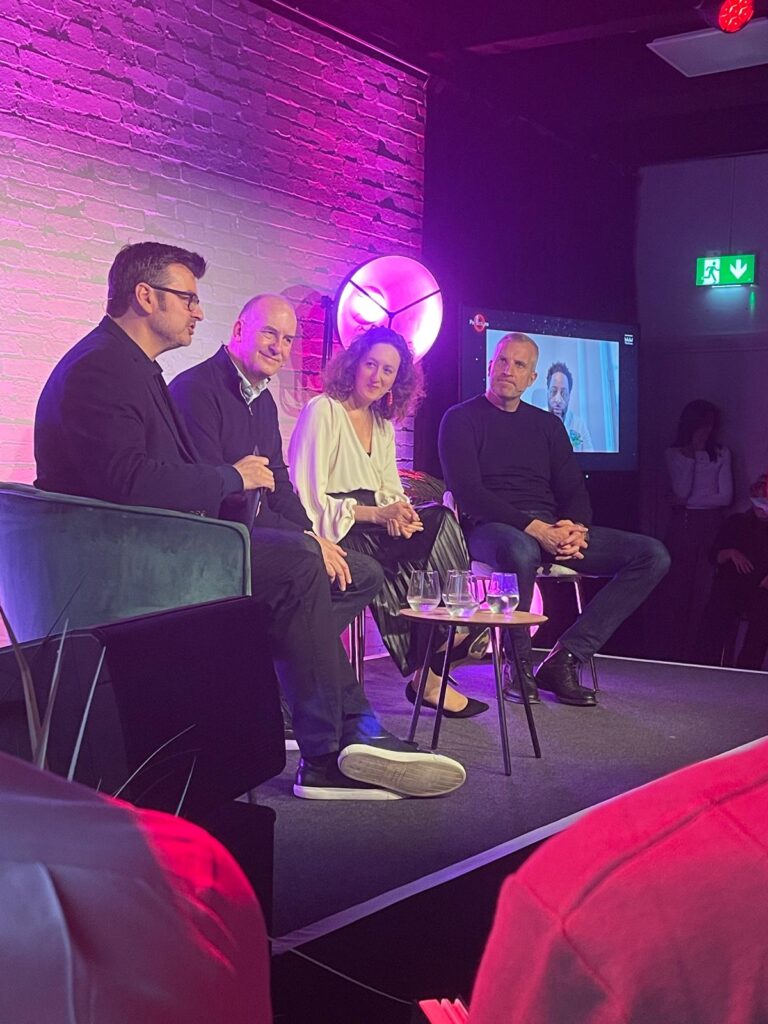
Led by Sam Anderson, this session reframed customer experience as an operating system rather than a communications layer. Johanna Gerhold from HelloFresh demonstrated this vividly. When a box arrives late or damaged, the entire experience collapses regardless of how strong the marketing is. HelloFresh has responded by aligning marketing, logistics and operations around one metric, the number of perfect boxes delivered. Their “Bring Back Dinner Time” campaign celebrated everyday moments and proved that extraordinary growth often comes from doing the ordinary exceptionally well.
Landor, Iris and Kantar reinforced the need for emotional intelligence, listening and clear intent. LEGO was cited as a brand that consistently turns service issues into moments of connection. Octopus Energy proved that perceived difference can drive growth just as effectively as functional difference. Empathy is no longer a point of distinction. It is the basic expectation.
Perspective, not panic
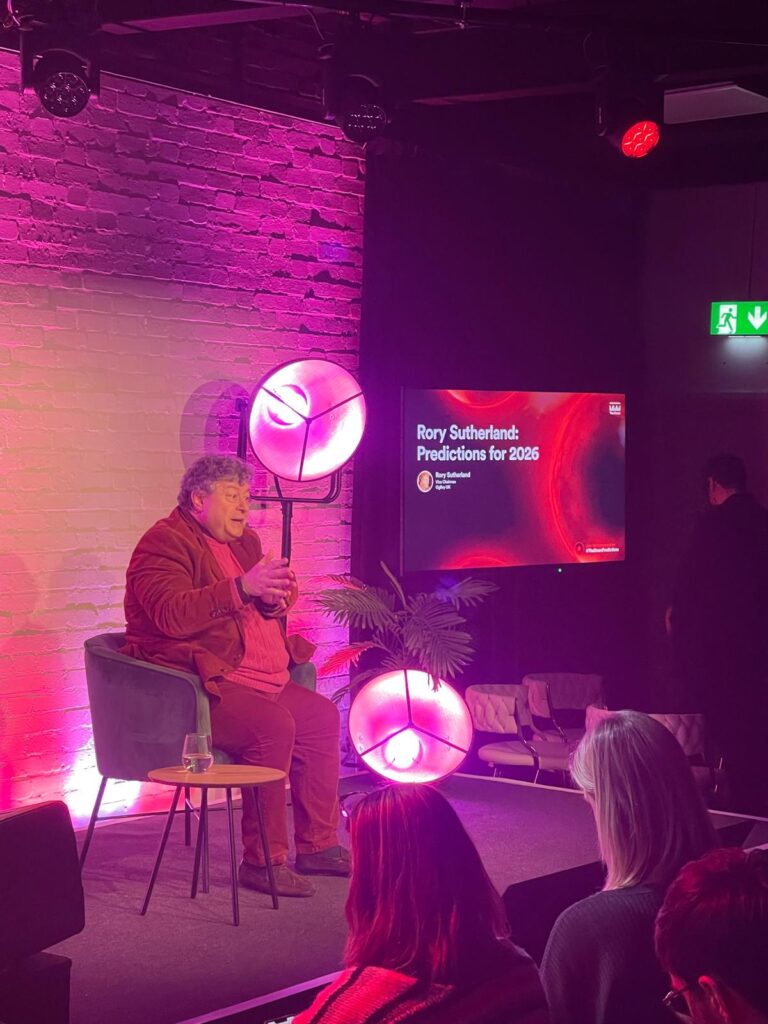
Mark Ritson brought a welcome dose of perspective. AI continues to evolve but currently contributes only a small share of total marketing impact. Synthetic data is one immediate area of opportunity because it provides speed and cost advantages without reducing quality.
His broader advice was simple. Sharpen your positioning. Remove the clutter. Avoid over‑engineering. If a positioning document runs beyond a page, it is too long. With political and economic uncertainty set to continue for the next year or two, clarity becomes a genuine competitive advantage.

Man vs machine: Marketing to agents
Daniel Hulme explored the rise of agentic AI and the implications this carries. Increasingly, marketers are engaging with AI agents that filter information, recommend products and, at times, make the decision themselves. This changes how we think about SEO, content architecture and brand trust.
Structured data becomes essential, credibility and evidence gain more weight and emotional resonance still matters. Governance, however, becomes the core requirement. Hulme compared AI governance to plumbing. It is largely invisible, completely essential and where most of the effort lies. He pointed to three long term differentiators: stronger data, better capability and leadership that knows how to apply both.
Sensory disruption and the return of brand
Jenni Baker led a session where voices from Ipsos, the Advertising Association and leap challenged the industry’s obsession with digital efficiency. Over‑optimisation, they argued, is pushing brands into a downward spiral of safe, flat and ultimately ineffective work.
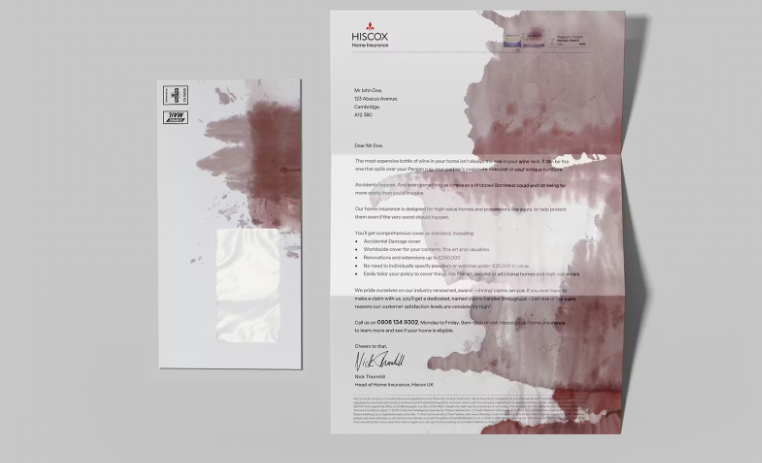
Print resurfaced as a surprisingly powerful channel, not through nostalgia but because it reaches people at moments when they are receptive rather than distracted. The Hiscox wine spill campaign demonstrated how physical and digital channels can complement one another when used well. A more structural concern also emerged. Two generations of marketers have grown up without meaningful experience across the full channel mix, and that knowledge gap is becoming a leadership issue.
Shaping consumer behaviour in 2026
Chris McCrudden from Edelman grounded the conversation in how people are genuinely behaving. Across developed markets, people are acting as if they are in a recession even when economic measures suggest otherwise. Cognitive bandwidth is low, trade-offs dominate daily life and brands increasingly operate as tools for reducing risk rather than creating excitement. Certainty is winning over novelty. Trust, once spent, does not replenish itself.
Cultural signals such as declining social media use, rising offline communities and a renewed interest in analogue experiences suggest that people want slower, more meaningful engagement. McCrudden’s term “slopapocalypse” captured the exhaustion with endless streams of low‑effort content perfectly.

Social: From reach to relationships
The final session, featuring Born Social, Garnier, Primark and Canva, reframed social media as a space that is fragmenting rather than disappearing. The shift is moving away from volume towards meaning. Silent signals such as saves, shares and comments are now more accurate indicators of intent than impressions. Garnier’s use of comment mining as a proxy for purchase intent illustrated this shift clearly.
The panel also noted that discovery on social media does not automatically become purchase on social media, and many traditional metrics still fail to connect to genuine growth. Looking ahead to 2026, they forecast slower storytelling, fewer outputs and more unfiltered content. AI will increase scale, but human judgement will still decide what deserves to be scaled.
A return to proper marketing
Across every session, the same conclusion emerged. Marketing is returning to what has always worked. The right message in the right place at the right time supported by strong brands, real human understanding and disciplined choices. The brands that succeed in 2026 will be the ones that act deliberately, protect trust carefully and recognise that value is created through human experience long before it appears in a metric.